
In May 2023, Mercedes-Benz gave Faker—a League of Legends player—a car worth €108,000, not as paid advertising or product placement, but as partnership. Faker doesn't review cars or create automotive content. He plays video games professionally.
For most brands, that decision would require explaining. For automotive brands entering esports between 2016 and 2026, it made perfect sense. Any 26-year-old esports fan watching Faker receive that Mercedes probably won't buy that car in the same year. But in four years, when they're 30 and earning, they'll remember which brands showed up in esports—and which didn't.
Automotive sponsors operate on multi-year commitments and demographic plays measured in decades. They build consideration sets before competitors recognise the opportunity exists.
Why Automotive Brands Sponsor Esports
The esports audience isn't buying cars today. They're building brand preferences that will influence purchases in five, ten, fifteen years. Automotive brands entered esports for three strategic reasons, each tied to long-term market positioning rather than immediate sales.
Reaching Future Car Buyers
The 16-35 age group represents prime first-time car buyers—tech-savvy early adopters who value innovation and prove difficult to reach via traditional media. Digitally native audiences require digital-first engagement strategies, which is precisely what esports provides. Automotive brands didn't enter esports to sell cars to teenagers; they came to associate their technology, innovation, and brand prestige with audiences before those audiences enter the market.
Innovation as Brand Currency
Electric vehicles, autonomous driving features, in-car connectivity, digital integration—automotive brands showcase these technologies to audiences that value them, using esports as a platform for forward-thinking positioning. The association places brands at the intersection of technology and entertainment, countering perceptions of automotive as traditional or conservative.
First-Mover Advantage
Building brand affinity before competitors establish presence creates long-term consideration sets. When today's 26-year-old esports fan turns 30 and buys their first car, the brands active in esports won't be strangers—they'll be familiar names associated with competitions, teams, and moments that mattered.
The Long-Term Commitment Model
Automotive brands in esports operate on timelines foreign to other sponsors. The market for automotive sports sponsorships stands at €18 billion (2024), projected to reach €27 billion by 2035—a 3.69% annual growth rate. Within this market, event sponsorships command €5.4 billion, team sponsorships €5.1 billion, and title partnerships €4.5 billion.
Esports represents a fraction of this total, but the brands that entered brought traditional automotive sponsorship thinking: multi-year commitments, sustained presence, partnership over activation. Where snack brands test and iterate, automotive brands commit or exit.
Commitment Patterns (2016-2026)
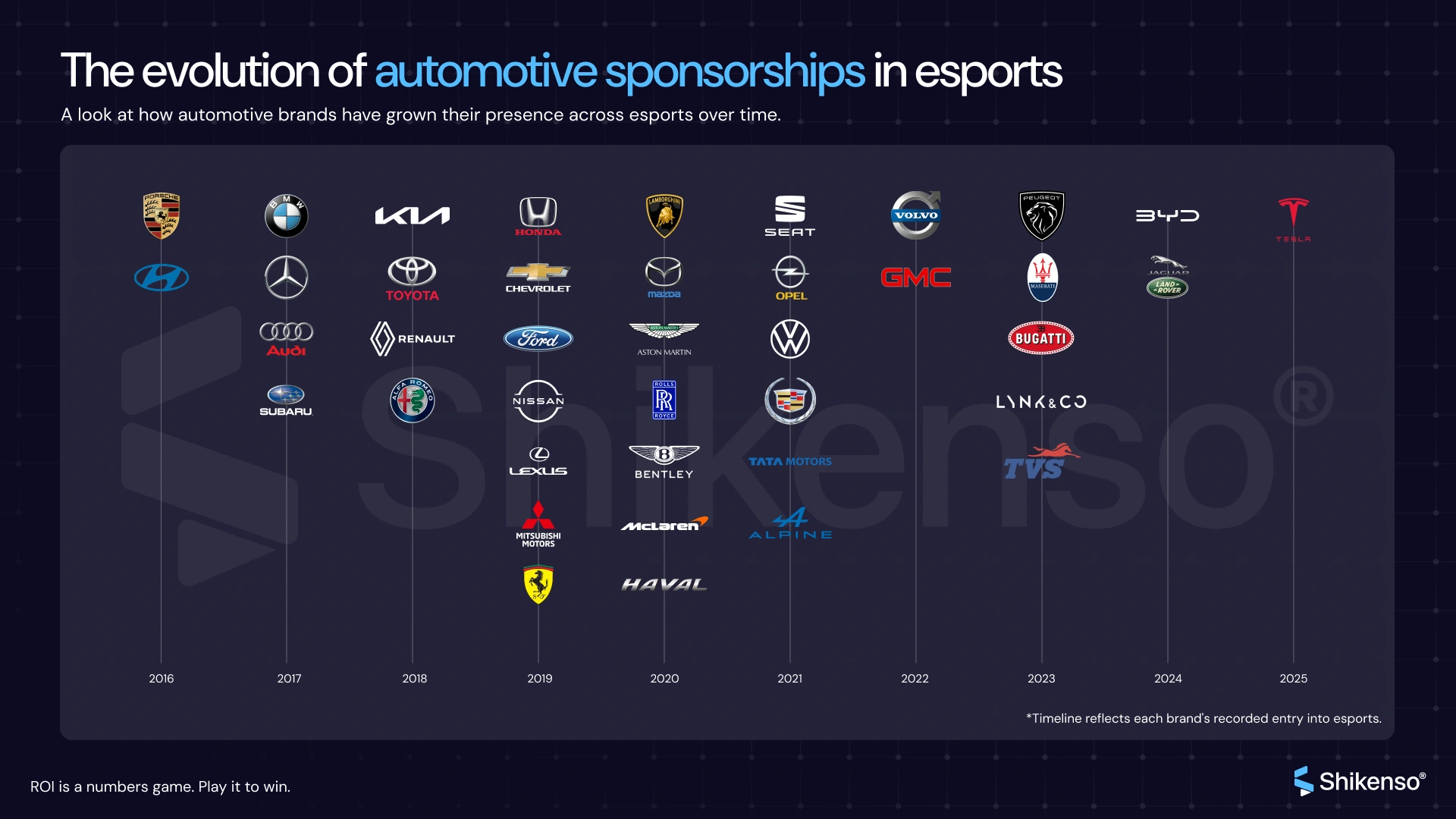
The data reveals clear patterns. German premium brands dominate the category, with partnerships running 3-5 years minimum as standard. Multi-team strategies outweigh single-team deals across active sponsors. The commitment levels separate automotive from other sponsorship categories—brands either dedicate long-term budgets or avoid the space entirely.
Complete Automotive Brand Timeline (2016-2026)

Three Partnership Approaches
Automotive brands in esports deployed three distinct models between 2017 and 2026. Analysing these reveals different risk profiles, cost structures, and strategic objectives.
Model 1: Portfolio Diversification (BMW)
Approach: Five simultaneous team partnerships across three continents
Brands: BMW (T1, G2, Cloud9, Fnatic, FunPlus Phoenix)
Launch: 2020
- Strategic Logic: BMW spread risk across multiple organisations and regions. If one team underperformed, four others maintained presence. The "United in Rivalry" campaign prioritised brand association with esports innovation over specific competitive results.
- Cost Implications: Higher total spend across five partnerships, but lower dependency on single-organisation performance. Budget distributed rather than concentrated.
- What It Reveals: Brands uncomfortable with competitive volatility choose portfolio approaches. BMW didn't need any one team to win championships—it needed the collective association with top-tier esports to reinforce innovation positioning.
Model 2: Publisher Integration (Mercedes-Benz)
Approach: Direct partnership with game publisher + strategic team sponsorship
Brands: Mercedes-Benz (Riot Games global partner + T1)
Launch: ESL One Hamburg 2017, evolved to Riot partnership 2023
- Strategic Logic: Mercedes went upstream. Instead of partnering with teams competing in Riot Games titles, Mercedes partnered with Riot itself. Publisher partnerships provide access across multiple titles, events, and regions simultaneously. The T1 partnership added depth through Faker's €108,000 Mercedes and cultural moments.
- Cost Implications: Publisher partnerships command premium pricing but deliver broader reach. Single contract replaces multiple team/event negotiations.
- What It Reveals: Brands seeking ecosystem-level presence choose publisher integration. Mercedes positioned itself as infrastructure partner embedded in competitive League of Legends, not just another sponsor competing for jersey space.
Model 3: Regional Depth (KIA)
Approach: Single-league, sustained presence
Brands: KIA (LEC)
Launch: 2019, still active 2026
- Strategic Logic: KIA committed to one regional ecosystem for seven years. No global expansion. No multi-property portfolio. Just sustained LEC presence providing consistent exposure to European League of Legends audiences.
- Cost Implications: Lower total spend than portfolio or publisher approaches. Budget concentrates on single property, building depth over time.
- What It Reveals: Brands targeting specific regional markets choose depth over breadth. For a South Korean manufacturer entering European markets, LEC provided stable access to premium audiences without complexity of multi-property management.
Pattern Analysis: What the Models Tell Us
Risk Tolerance:
- Low risk tolerance → Portfolio diversification (BMW)
- Medium risk tolerance → Regional depth (KIA)
- High commitment → Publisher integration (Mercedes)
Budget Allocation:
- Distributed spend → Multiple teams (BMW)
- Concentrated spend → Single league (KIA)
- Premium spend → Publisher partnership (Mercedes)
Objectives:
- Innovation association → Portfolio model
- Market entry → Regional model
- Ecosystem positioning → Publisher model
Automotive brands don't choose partnerships randomly. The model reveals strategic priorities, budget constraints, and risk appetite.
Regional Dominance & Strategic Divergence
German Brands Lead Premium Positioning
Germany dominates automotive esports sponsorships through BMW, Mercedes-Benz, and Audi—all premium manufacturers from the same market. These brands favour luxury positioning over mass-market approaches and commit to multi-year strategies running 3-5 years as standard. The pattern suggests German automotive culture aligns with long-term brand building rather than short-term activation tests.
Global Distribution Varies by Region
KIA's sustained LEC partnership demonstrates South Korean commitment to European markets. Hyundai and Honda appear in timelines with varying regional activations, though specific market strategies differ by geography. North America shows limited direct automotive brand activity despite Cloud9's BMW partnership representing the region within "United in Rivalry." The relative absence of automotive sponsors in North American esports, compared to Europe's concentration, presents growth opportunity.
Luxury Brands Test Cautiously
Ferrari and Lamborghini appear in historical timelines but demonstrate limited active partnerships. Porsche's current status remains unclear following 2016-2023 timeline mentions. Premium and ultra-luxury brands test more cautiously than volume manufacturers, preferring selective activations over sustained ecosystem integration.
Future Outlook
The EV Transition Creates New Narratives
Electric vehicle adoption accelerates globally, providing automotive brands new positioning opportunities in esports. Sustainability messaging paired with technological advancement resonates with environmentally conscious Gen Z. Future activations will emphasise EV features, charging infrastructure, and green technology as esports demographics mature into car-buying age. Brands already associated with innovation through esports sponsorships can leverage that positioning when launching EVs.
Untapped Categories and Regional Gaps
Sim racing represents obvious overlap between automotive brands and esports, yet remains underutilised—BMW and Mercedes could expand into iRacing, Gran Turismo, and Forza Motorsport, titles where their products exist within the game itself.
Asian markets show growth potential following KIA's model, while North American esports remains underpenetrated despite Cloud9's BMW partnership. Latin American esports growth could attract brands seeking younger demographics in emerging markets, and Web3 plus metaverse technologies offer activation spaces for virtual showrooms and digital car ownership within games.
The Bottom Line
Twenty years from now, when today's 26-year-old esports fans buy their third or fourth car, they won't remember specific activations or jersey patches. They'll remember that BMW, Mercedes, and KIA were present during competitions they cared about. Automotive esports sponsorships don't work on quarterly timelines—they work on generational ones.
Related reads

Get new insights straight to your inbox
Don’t miss out on the insights that the press and media rave about!